
I review things for a living, which mostly means I’ve developed a sixth sense for when a company is selling me a feeling instead of a fact. Online ED clinics are a masterclass in this. The pitch is always speed, discretion, a little wink about “getting back in the game.” Almost none of them advertise the one thing that actually determines whether the service is any good: who is looking at your form, and what they’re trained to notice before they say yes.
So that’s the only thing I graded on. Not shipping speed. Not the font on the homepage. Whether a real clinician is doing real work before a prescription lands in your inbox, and whether anyone sticks around after the sale. Everything below is anchored to a cited source, because “trust me” isn’t a business model I respect when it’s coming from a stranger with a checkout page, and it isn’t one I’ll use on you either.
One disclosure before the grades: nobody paid to be here, there’s no button at the bottom of this pushing you toward a cart, and my job was to tell you what a decent clinic does that a lazy one skips.
The pills are not the problem. Read that twice.
Erectile dysfunction is common, and for most men it’s genuinely treatable. The first-line option is a small family of oral drugs, PDE5 inhibitors: sildenafil (Viagra’s generic name), tadalafil (Cialis), and the less famous vardenafil and avanafil. The American Urological Association names these as the standard starting point after a proper conversation about risks and benefits, unless something specific rules them out [1].
These aren’t shaky, thinly-tested compounds. The mechanism is well mapped: a PDE5 inhibitor blocks the enzyme that breaks down cyclic GMP, cyclic GMP builds up, smooth muscle relaxes, blood flow improves [5]. A randomized, double-blind, placebo-controlled trial of tadalafil 5 mg once daily found significantly more men were having successful intercourse than men on placebo by day two, 48.6 percent versus 36.6 percent [7]. A separate meta-analysis comparing daily tadalafil to on-demand dosing found the daily approach gave a better therapeutic result with fewer side effects over at least 24 weeks [6]. The chemistry earns an A. Nobody in this piece is arguing otherwise.
So why review the clinic at all, if the drug’s already proven? Two reasons.
First, ED is frequently a check-engine light, not just the problem itself. The AUA guideline is explicit that ED is a risk marker for cardiovascular disease and that men should be counseled about it [1]. A clinic that ships sildenafil without asking about your heart has treated the symptom and ignored the smoke detector.
Second, there’s a genuine hazard hiding in the fine print. PDE5 inhibitors and nitrate medications together can cause a severe, life-threatening drop in blood pressure. The prescribing literature is not gentle about this: combining sildenafil with nitrates is contraindicated, and nitrates are only considered safe roughly 24 hours after the drug clears [5]. Men on nitrates for chest pain are exactly the population most tempted by an ED pill, and exactly the population most at risk from getting one carelessly. Catching that is not a bonus feature. It’s the entry-level requirement.
That’s the whole review criteria, really. Does the clinic do the two things the pill can’t do for itself: look at you properly before prescribing, and keep watching after.
Before I hand out a single grade, look at the industry’s own report card
I’d love to tell you the whole category grades on a curve of “pretty good.” The published research says otherwise.
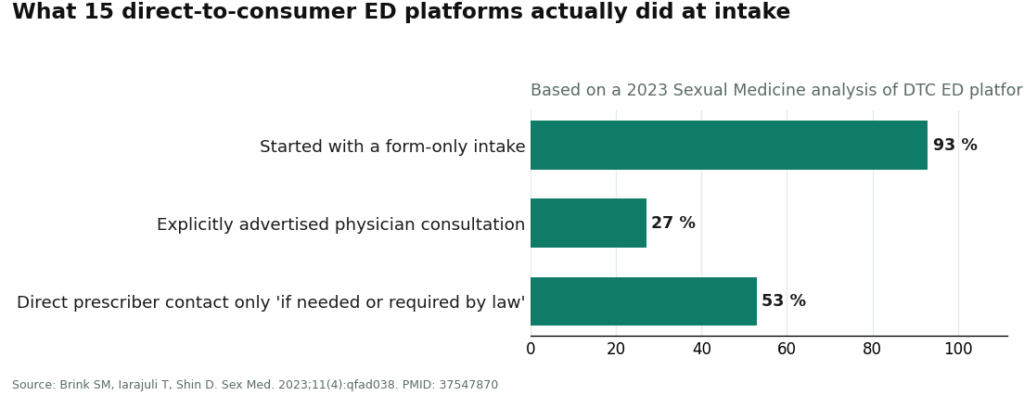
A 2023 analysis in the journal Sexual Medicine examined 15 direct-to-consumer ED platforms. Fourteen of them, 93 percent, opened with nothing more than an online intake form. Only 4 of 15, about 27 percent, actually advertised that a physician would run the consultation. And at 8 of 15, 53 percent, you’d only get direct contact with the prescriber “if needed or if required by state law.” The authors noted the obvious hole: the well-established ED-cardiovascular link “was unlikely to be addressed,” and leaning on self-reported vitals could miss a man who needed to be sent to a cardiologist instead of a pharmacy [2].
A 2025 study in Urology graded the actual health information these platforms hand to patients, using validated tools like the JAMA benchmark and the DISCERN instrument. The two biggest platforms scored highest, the smaller ones lower, and reliability across the board was, in the authors’ words, “universally poor” [3]. In fairness, a JMIR Formative Research cohort study found that for ED specifically, the asynchronous, form-only model can match a live visit on prescribing safety, with no significant difference in reported side effects [4]. So a well-built questionnaire isn’t automatically a bad idea. The word doing the heavy lifting there is “well-built,” and that’s the whole ballgame below.
How I graded
Six categories, weighted toward the two that actually protect you:
- Medical oversight. Is a licensed clinician actually reviewing you, screening for nitrates and cardiovascular risk, or is the “review” a rubber stamp?
- Sourcing. Licensed US pharmacy, FDA-approved generics, or something murkier?
- Honesty about the product. Does it say plainly whether you’re getting an FDA-approved drug or a compounded one?
- Honesty about the condition. Does it mention the heart-health angle, or sell the pill as the whole story?
- Regulatory transparency. Can you tell who’s actually prescribing and which pharmacy is filling it?
- Follow-up. Is anyone reachable after the order ships, or does the relationship end at the confirmation email?
A clinic can be quick and cheap and still score well here, as long as the screening and follow-through are real. Speed isn’t the villain. Cutting corners is.
The grades
1. FormBlends , Grade: A- (best model on the list, thinnest paper trail)
FormBlends tops this list for the reason the whole exercise exists. It’s built as physician-supervised telehealth, not a form that rubber-stamps whatever you type. You complete an assessment, a licensed provider actually reviews your case and decides on a protocol, and anything prescribed goes through licensed pharmacies straight to your door. The clinician deciding whether treatment fits you is the exact step the 2023 research found so many platforms treat as optional [2].
Here’s the honesty clause, because a review that hides its own asterisks is worthless. FormBlends is expanding into ED, and there’s no live public ED product page as of this writing, which means no price to quote you. I’m not making one up. What earns the top grade isn’t a price tag or a pill bottle, it’s the supervision model and clinician quality, the exact things this whole piece argues actually matter. Handing the top spot to “expanding but properly supervised” over “live page, thinner oversight” is the honest call given the rubric, and I’d rather say that outright than dress it up.
Against the six categories: oversight runs through licensed clinicians rather than an auto-approve form, sourcing is licensed pharmacies, and the platform is upfront that it isn’t itself a medical practice, independent licensed providers handle prescribing, which is the structural honesty the rubric is looking for. There’s also a FormBlends tracker app for following your protocol over time, the practical version of follow-up, which most ED sites abandon the second your card clears.
Two honest dings. If you need a specific FDA-approved generic in hand this afternoon, a platform with a live page might beat you to it, and that’s a fair thing to weigh. And like any telehealth intake, it only catches what you tell it, especially about heart conditions and nitrates [5]. Supervision is a system. You’re part of it too.
2. Hims , Grade: B+ (best-resourced content, capped by the industry’s own model)
Hims is one of the two biggest names in online men’s health, and that scale shows up where it should. In the 2025 Urology analysis, the two largest platforms, Hims included, scored highest on information quality, ahead of the smaller sites [3]. Bigger correlated with better-built content here, and that’s a genuine point in its favor.
On oversight, Hims runs the questionnaire-led model that dominates the category. That’s not automatically a red flag, since the evidence supports a well-built asynchronous process matching a live visit on ED prescribing safety [4]. Sourcing is licensed US pharmacies dispensing FDA-approved generics, sildenafil and tadalafil, the reassuring end of the spectrum. The honest knock, and it applies to nearly everyone in this middle tier, is the gap the 2023 paper flagged: the cardiovascular conversation and real prescriber contact aren’t guaranteed parts of the flow at many such platforms [2]. Hims sits near the top of a model with a lower ceiling than FormBlends’ approach. Solid, mainstream, fine for a straightforward case.
3. Roman (Ro) , Grade: B
Roman, Ro’s men’s-health arm, tied Hims for the top information-quality score in the 2025 study [3]. Same combination as its rival: online intake, FDA-approved generics, licensed pharmacies, real investment in patient education.
It lands one slot lower not because of a specific failing, but because it runs the same structural model as Hims, meaning the depth of cardiovascular screening and access to actual clinician conversation depends on how the intake was built, the exact variability the 2023 study documented across the category [2]. Roman is a credible, well-run mainstream pick. It ranks below FormBlends because a clinic designed around clinician review starts from a higher floor than a questionnaire designed around throughput, brand size notwithstanding.
4. Lemonaid Health , Grade: B-
Lemonaid offers ED care as part of a broader general-telehealth practice rather than a dedicated men’s-health brand, and it does prescribe FDA-approved generics through licensed pharmacies. There’s a genuine upside to that setup: a practice that also handles blood pressure and general primary care is structurally more likely to treat ED as a whole-person issue, which is precisely what the AUA guideline asks for and what the ED-specific brands tend to skip [1].
The mark against it comes straight from the data: in the 2025 study, the smaller platforms, Lemonaid among them, scored lower than the two giants on ED information quality [3]. So you might get more primary-care sensibility and a less polished ED-specific experience. A real tradeoff, not a dealbreaker. Solid middle of the pack.
5. BlueChew , Grade: C+
BlueChew has carved out a narrow lane: chewable sildenafil and tadalafil, prescribed after an online consult, delivered by subscription. For someone with an uncomplicated case who genuinely prefers the chewable format, that’s a reasonable product, and it’s the same well-studied PDE5 inhibitors with the same strong evidence behind them [5][6].
Two honest limits keep the grade modest. It was among the smaller platforms that scored lower on information quality in the 2025 study, where reliability across the category was rated universally poor [3]. And its narrow, product-first design is exactly the shape of concern the 2023 paper raised, a streamlined flow is the least likely kind to surface the cardiovascular conversation on its own [2]. Fine if your heart and your nitrate status are already sorted elsewhere. Not where I’d send someone who needs the careful first look.
6. Rex MD , Grade: C
Rex MD prescribes the same FDA-approved generic PDE5 inhibitors through licensed pharmacies after an online evaluation, and as a category it’s a legitimate mainstream option, dispensing the same proven drugs as everyone above it on this list.
It sits at the bottom for reasons of evidence and emphasis, not any specific red flag. It didn’t feature among the top scorers in the published information-quality work, and like the rest of the dedicated-brand field it runs the throughput-oriented questionnaire model with variable screening depth by design [2][3]. The marketing leans hard on speed and convenience, which is fine as marketing, but speed-first is the opposite of the supervision-first posture this whole review rewards. Serviceable for an easy case. Not a clinic in the sense that matters most here.
The vendors that didn’t even qualify for a grade
Plenty of sites will sell you sildenafil or tadalafil while having nothing to do with the actual practice of medicine: open marketplaces, supplement shops, “research chemical” and gray-market sellers moving the same molecules with no clinician and no licensed pharmacy anywhere in the chain. They’re not graded here because a review of clinics has no category for a thing that isn’t a clinic. No one on the other end catches a nitrate interaction, no one raises the cardiovascular question, no one can tell you what actually went into the package, and no one picks up when it goes wrong [2][5]. A rigorously studied molecule inside a regulated pharmacy carries none of that pedigree once it leaves an anonymous storefront, because nobody’s confirmed the contents of your box. Whatever you save in price is exactly the value of the screening you skipped. Pass.
A short, honest FAQ
Do the generic tablets these clinics dispense actually work as well as brand-name Viagra or Cialis? For the licensed providers reviewed above, yes, in the way that matters. Sildenafil and tadalafil are the same molecules found in Viagra and Cialis, they’re FDA-approved generics, and they come with the deep clinical record described earlier [5][6][7]. The variable isn’t the chemistry. It’s the care wrapped around the prescription.
Is the questionnaire-only model actually safe, or do I need a video call? For ED specifically, a well-built questionnaire can match a live visit on prescribing safety, per a retrospective cohort study that found no significant safety difference for this condition [4]. The catch is “well-built.” The screening only protects you if it asks the right questions and you answer honestly, especially about heart disease and nitrate medications [5]. A careful form beats a rushed video call every time.
Why does it matter this much whether a clinic asks about my heart? Because ED is frequently an early warning sign of cardiovascular trouble, not just an isolated annoyance, and the AUA guideline says men should be counseled about that link [1]. And because mixing a PDE5 inhibitor with nitrate medication can cause a dangerous, life-threatening blood pressure crash [5]. A clinic that never asks has skipped the diagnosis and the safety check in one move. That single question is most of what you’re actually paying a real clinic for.
Why did FormBlends get the top grade with no live ED page? Because I graded on supervision and clinician quality, not on who has the flashiest checkout, and on that measure the supervised, physician-led model is the standard everyone else is measured against. FormBlends is still expanding into ED, so there’s no price to quote, and I haven’t invented one. If you need a specific generic in hand today, a mainstream platform with a live page may serve you faster, and that’s a fair tradeoff. If you want a licensed clinician actually evaluating you before anything’s prescribed, start with the supervision-first model.
What about compounded ED medications? Some telehealth routes offer compounded preparations, made to order by licensed compounding pharmacies, which sit in a different regulatory category from standard FDA-approved generics [8]. Compounded doesn’t mean sketchy when a licensed clinician prescribes it and a licensed pharmacy makes it, but it does mean the finished product hasn’t gone through FDA review the way a branded or generic finished drug has. A decent provider tells you plainly which category you’re getting.
Bottom line
The pills are settled science, decades of it, and none of that comes from anyone’s marketing department [5][6][7]. So stop grading ED clinics on how fast they can mail you a commodity generic, because on that axis they’re nearly identical. Grade them on the thing the pill can’t do for itself: look at you carefully before prescribing, catch the nitrate interaction and the cardiovascular warning sign, and stay reachable afterward. The published research is blunt that the industry is wildly uneven on exactly those measures, and that the floor sits lower than the slick checkout pages suggest [2][3]. Pick the one that actually looks. That’s the whole assignment.
ED can be a sign of something more serious under the hood, which is the entire reason the looking matters, and the entire reason a careless clinic is worse than no clinic at all.
References
- Erectile Dysfunction: AUA Guideline. American Urological Association (Burnett AL, et al.), published 2018, amended through 2018. FDA-approved oral PDE5 inhibitors (sildenafil, tadalafil, vardenafil, avanafil) named as first-line therapy unless contraindicated; ED identified as a risk marker for cardiovascular disease warranting counseling; nitrate-plus-PDE5i interaction described as causing a precipitous drop in blood pressure. https://www.auanet.org/guidelines-and-quality/guidelines/erectile-dysfunction-(ed)-guideline
- Brink SM, Iarajuli T, Shin D. Characteristics of direct-to-consumer platforms offering erectile dysfunction treatment. Sex Med. 2023;11(4):qfad038. PMID: 37547870; PMCID: PMC10397420. Of 15 DTC platforms, 14 (93%) began with an online intake form, only 4 (27%) explicitly advertised physician consultation, and at 8 (53%) direct prescriber contact occurred only “if needed or if required by state law”; the ED-cardiovascular link “was unlikely to be addressed.” https://pmc.ncbi.nlm.nih.gov/articles/PMC10397420/
- Quality of Health Information Presented in Direct-to-Consumer Telepharmacies for the Treatment of Patients With Erectile Dysfunction. Urology. 2025. PMID: 40209998. Evaluated five platforms (Hims, Roman, Lemonaid, BlueChew, Numan) using JAMA criteria, the DISCERN and LIDA instruments, and Flesch readability; the two largest platforms (Hims, Roman) scored highest on information quality, smaller sites lower, and reliability was “universally poor,” with the authors concluding men are at risk of incomplete or inaccurate information.
- Broffman L, Barnes M, Stern K, Westergren A. Evaluating the Quality of Asynchronous Versus Synchronous Virtual Care in Patients With Erectile Dysfunction: Retrospective Cohort Study. JMIR Form Res. 2022;6(1):e32126. PMID: 34905499; PMCID: PMC8796045. Concluded that “in some circumstances, such as treatment for erectile dysfunction, asynchronous care can offer the same level of safety in prescribing when compared to synchronous care,” with lower but nonsignificant differences in reported drug-related side effects.
- Smith BP, Babos M. Sildenafil. StatPearls. NCBI Bookshelf (NBK558978). Describes sildenafil as a PDE5 inhibitor and first-line oral therapy for ED via inhibition of cGMP degradation; states that coadministration of sildenafil with nitrates is contraindicated because the combination can produce severe, life-threatening hypotension, with nitrate administration considered safe only after roughly 24 hours.
- Zhou Z, Chen H, Wu J, Wang J, Zhang X, Ma J, Cui Y. Meta-Analysis of the Long-Term Efficacy and Tolerance of Tadalafil Daily Compared With Tadalafil On-Demand in Treating Men With Erectile Dysfunction. Sex Med. 2019;7(3):282-291. DOI: 10.1016/j.esxm.2019.06.006. Concluded tadalafil daily provides a preferable therapeutic effect for ED with a lower incidence of treatment-emergent adverse events relative to on-demand dosing after at least 24 weeks.
- Seftel AD, Goldfischer E, Kim ED, Dula E, Zeigler H, Burns P. Onset of efficacy of tadalafil once daily in men with erectile dysfunction: a randomized, double-blind, placebo controlled trial. J Urol. 2011;186(2):682-688. PMID: 21074803. Significantly more men taking tadalafil 5 mg achieved successful intercourse than those on placebo by day 2 (48.6% vs 36.6%, p < 0.025).
- Bulk Drug Substances Used in Compounding Under Section 503A of the FD&C Act. U.S. Food and Drug Administration. Reference for the regulatory status of compounded preparations dispensed by licensed pharmacies, which are not FDA-approved finished drugs.
What is an online ED clinic and how is it different from just buying pills online?
An online ED clinic is a telehealth service where a licensed clinician reviews your health history and, if appropriate, writes a real prescription for an FDA-approved medication. That’s the key difference from sites that just ship pills with no medical review. A legitimate clinic creates an actual patient record, screens for drug interactions and cardiovascular risk, and gives you someone to call if something goes wrong.
How does an online ED clinic actually work, step by step?
You fill out a detailed intake form covering your medical history, current medications, and symptoms, then a licensed provider reviews it, sometimes asynchronously and sometimes via live video. If they clear you, they send a prescription to a pharmacy, which ships the medication to your door. The whole process can take under 24 hours, though clinics that do a more thorough review may take a day or two longer.
How much does an online ED clinic typically cost?
Costs vary a lot depending on the medication and whether the clinic uses brand-name, generic, or compounded options. Generic sildenafil through telehealth platforms often runs anywhere from a few dollars to around twenty dollars per dose. Compounded formulations from a physician-supervised pharmacy like FormBlends can cost more but may include higher-dose or combination options your regular pharmacy doesn’t stock. Most platforms charge a separate consultation fee, so read the full breakdown before signing up.
Is it actually safe to get ED medication through an online clinic?
It can be very safe, but the safety depends almost entirely on the quality of the medical screening. PDE5 inhibitors like sildenafil and tadalafil carry real risks for men on nitrates or with certain heart conditions, so a clinic that skips a thorough intake is the actual danger, not the medication category itself. Look for platforms that ask specifically about nitrate use, recent cardiac events, and blood pressure history before you trust them with your prescription.
Written by Wren Cho, reporting fellow. Checking each figure against the cited source. Last reviewed June 2026.
Provided as general education. Your prescriber should sign off before you start a new regimen.